Confluence by Treva Legassie
This annotated bibliography acts as a convergence of tributaries, a gathering and flowing together of narratives, that shapes the research for Sounding the Land: Soundwalking as transformative practice in the era of the climate crisis.
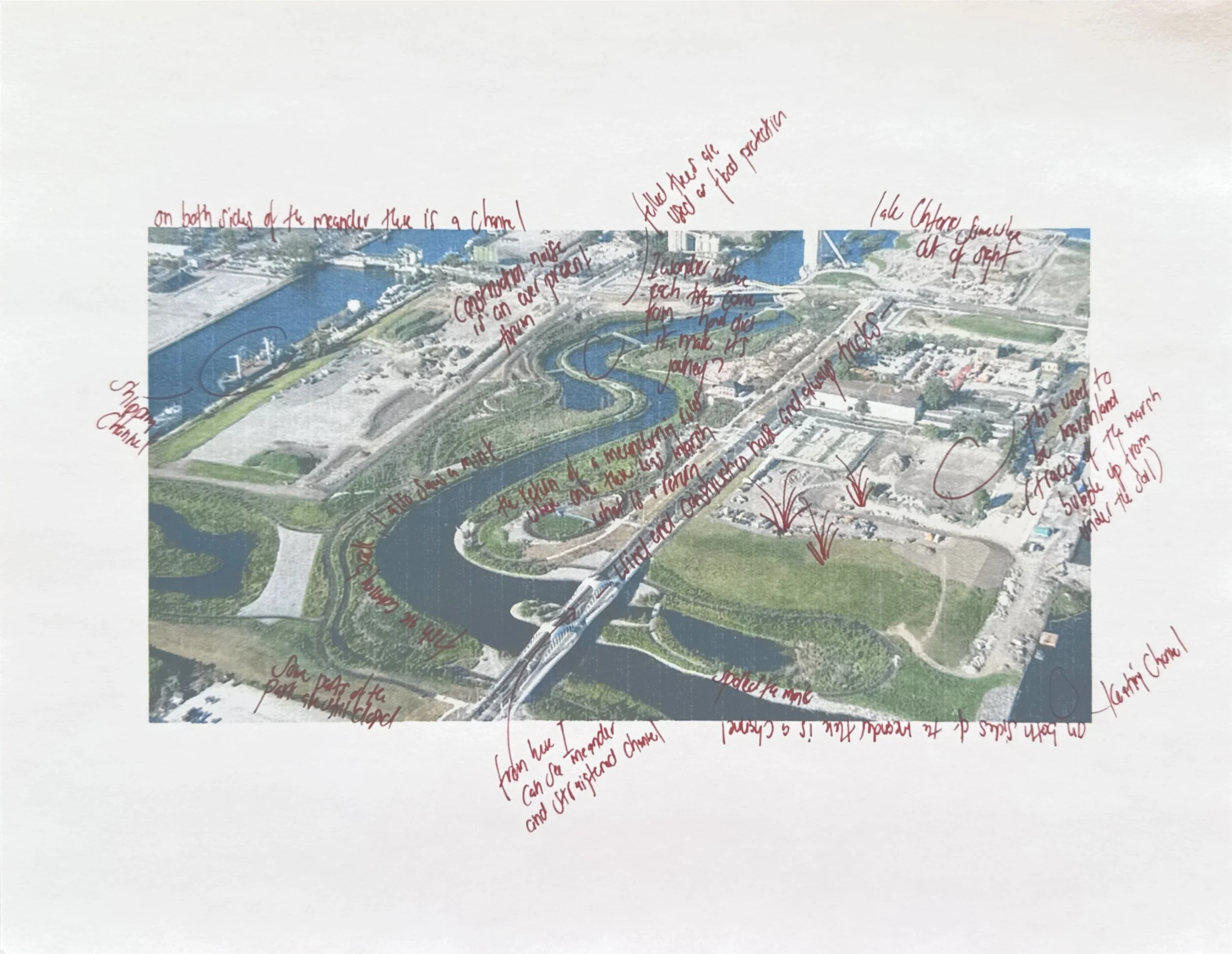
Annotated image of Biidaasige Park in Toronto seen from the CP24 chopper on July 18, 2025. Image courtesy of CP24 News online and Treva Legassie. If maps are meant to visualize, demarcate, lay claim, analyze, and wayfind, then this ‘annotated map’ of notes from the field moves otherwise. It obscures, connects, troubles, and conjures the experience of getting lost.
Thinking with places has made me comfortable with getting lost; a practice we are often encouraged to avoid for safety, for efficiency, to move from one point to another in the quickest and clearest way possible. Getting lost introduces us to other worlds and teaches us to listen differently, to learn, to know, and to remain with not knowing.
What follows is an archive of a research process. Composing an annotated bibliography is usually an academic exercise that summarizes and evaluates various references as they relate to a specific research project. To glean what is useful and ought to be carried forward. The annotations on this page are composed with generosity, rather than extraction, in mind. Here, annotation becomes a practice of relation. It works to bring forth a feminist politics of citation, one that understands citing, referencing, and annotating as ways of contouring knowledge and making relations felt. To annotate is to reflect, to linger, to relate.
Following research-creation’s process-led techniques, this ‘annotated bibliography’ constellates academic references, notes from the field, sounds, and images that move through, in, and from my SSHRC-funded postdoctoral fellowship: Sounding the Land: Soundwalking as Transformative Practice in the Era of the Climate Crisis. As my mind wanders I hope you will follow me in getting lost on the page, and in the field, as a manner of slowing down and attuning to what emerges when extraction is no longer the goal.
Sounwalking
A soundwalk is..
a listening exercise that helps us become aware
of our immediate acoustic environment.
It is also about the aesthetic pleasures of listening.
Listening to sounds we might otherwise have missed;
listening to the rhythm of sounds;
listening for the unique 'voice' of a city.
It's about enjoying the sensual beauty and sheer surprise
of sound... - Hildegard WesterkampSoundwalks are invitations. They invite attentive listening while moving through a particular space […] Practice listening without trying to grasp, take, control, know. - from As the mouth speaks, Treva Legassie. A geolocated soundwalk through Biidaasige Park (formerly the Port Lands), Toronto.
In “Soundwalking” Hildegard Westerkamp introduces the concept of soundwalking through a history of the practice and some written exercises meant to promote intense listening to our surrounding environments. For Westerkamp soundwalking activates a practice of “intense listening” in order to “rediscover and reactivate their sense of hearing” (18). I recall vividly the first time I experienced this kind of intense listening, an expansion of my sense of the world around me and all the lively forces of which I had been previously unaware.
Westerkamp traces the practice of soundwalking back to the “Sunday walk,” an urban activity meant to re-forge connections with nature; contrasted with the “Sunday drive,” which distances the body and prioritizes visual experience. Her soundwalk through Queen Elizabeth Park in Vancouver moves across shifting sonic scenes: from parking lot to fountain, to Knife Edge by Henry Moore (where listeners are encouraged to interact and compose), through the conservatory, into the Sunken Garden where city sounds recede, and finally toward the creek.
These soundwalking exercises explore listening as orientation—using the ear for wayfinding, attending to the melodies of voices when asking for directions, and observing how environments shape acoustics, especially through wind. Sound becomes both guide and material. In another time and place I found myself leading a soundwalk for art and design students through Grange Park, here Henry Moore’s Large Two Forms also conjures interaction, play and the chance to compose our own sonic scene.
—
Westerkamp, Hildegard. “Soundwalking” Sound Heritage 3, no. 4 (1974): 18-27, updated in Autumn Leaves: Sound and the Environment in Artistic Practice, edited by Angus Carlyle, 49-54. Paris: Double Entendre, 2007.
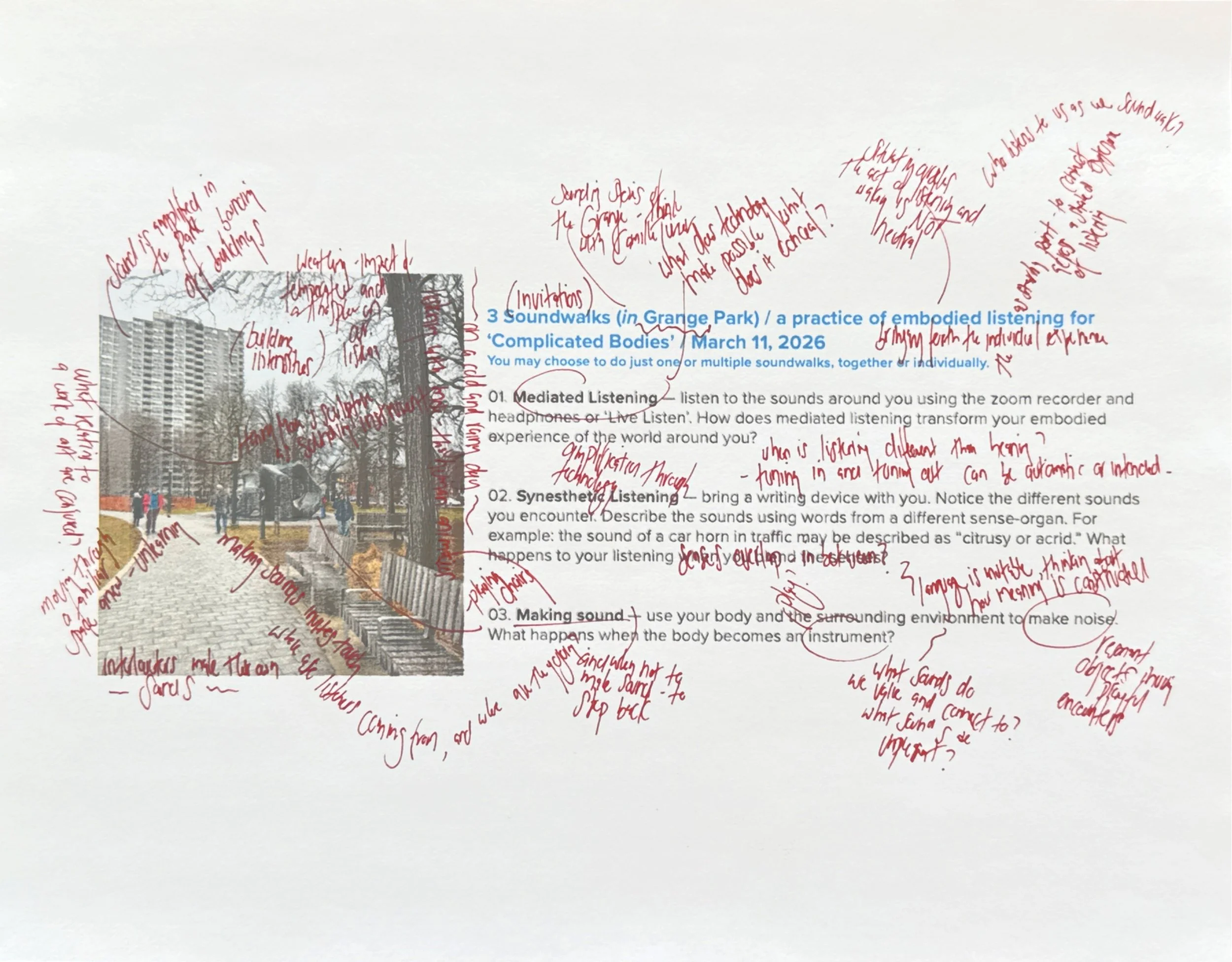
Annotated soundwalk instructions and photo from soundwalk in Grange Park, Toronto. Soundwalk instructions, photo and annotations by Treva Legassie.
From where we listen
Attunement means to bring into tune, to find resonances or moments of intersection. - AM Kanngieser & Zoe Todd
In their text “From Environmental Case Study to Environmental Kin Study,” AM Kanngieser and Zoe Todd propose a method for listening and attuning that counters the dislocation and abstraction of Western and colonial environmental case studies which abstract and try to apply universal stories from the study of particular places (rendering places as “data-sheds” for scholars). In returning to, and soundwalking in, particular urban-natural places over time I have come to unlearn how to listen, specifically those extractive practices taught to me by settler institutions that position listening in the field as a way to take something (take a recording, a piece of information, a document, etc.).
Kanngieser and Todd take up an onto-epistemological approach (that links knowing and being rather than the Western separation of ontology and epistemology), that reflects on Land and place as sets of relationships between human non-humans that co-constitute one another requiring historians maintain ethical and reciprocal relationships with Land and place. Environmental kin study requires practices of attunement. For Kanngieser “attunement is predicated on cultivating a close and generous attention.” They continue, “the shift from case studies to kin studies requires those writing histories of place to consider the ongoing, co constitutive, rooted, and flexible nature of place and our relationships to it” (2020; 387). Situating oneself is essential, as Kanngieser urges, white and non-indigenous scholars, must be aware of how we move through unceded sovereign lands to mitigate harm. Listening becomes an essential practice in “kin study” as for Kanngieser listening—as a “practice of sensing, attunement and noticing”—is a laborious, humbling, and self-reflective process that “requires the listener to become aware of their own limitations and assumptions about place and land” (2020; 390).
Developing an attunement practice as a “guest, a trespasser, and a colonizer” necessitates asking for permission continuously. When listening we are inside our own bodies, experiencing our breath, discomfort, disposition as our “presence is doing something” to where we are (2020; 390). Kanngieser notes, “attunement makes me aware of when to give thanks and leave, which is one of the most crucial lessons a researcher can learn” (2020; 390).
Elsewhere Kanngieser has expanded and grounded this practice of “taking-leave” through reflections on specific instances of field recording and developing an attuned sense of when to not press record, to stop or to turn back. Kanngieser urges that we need to acknowledge that our presence is doing something to the place we are at, and further, knowledge of environments are not always ours to ask for or to hear. They share, quote “To be able to listen to, and appreciate, what is not for us as Anglo-European scholars and artists is one of the most imperative things I have been taught to accept and practice” (Kanngieser 2021).
Practing recording in the field at Mount Batilamu above Abaca village in the Koroyanitu Heritage Park Kanngieser describes a feeling of atmospheric pressure rising to meet the recordist, a sense that the Land was saying ‘no’ to their request for permission to record. I understand this gut feeling. Sometimes we are not welcomed or meant to press record in the field, perhaps instead we must take-leave or maybe just be in a place without the desire to take something away with us when we leave. With this is mind I share an excerpt from my field journal;
I put on my headphones, turned up the volume and am met with the violent low-end rumbles caused by high winds, when air pressure pushes the microphone diaphragm to its physical limits. Sound is distorted, wind noise pushes back, evades capture and prevents me from making any field recordings.
Wind made it impossible for me to record the soundscape. I stayed and quietly observed a family of swans from a distance. I hadn’t seen them here before in such large numbers. As they slowly traversed down the new meandering river mouth I heard, for the first time, the trumpeting sound of one of the swans calling back to the rest of the group. It was wonderful. I felt no loss at the fact that this fleeting moment wasn’t captured on my zoom recorder. This sound was never meant for me, and certainly not meant for me to take away from this place as a sharable, usable .mp3 file.
—Notes from the field, Biidaasige Park, December 3, 2025.
—
Kanngieser, AM and Zoe Todd. “From Environmental Case Study to Environmental Kin Study.” History and Theory 59, no. 3 (2020): 385-393.
Kanngieser, AM. “Listening as method, part III: Listening as taking-leave.” Seedbox Environmental Humanities Lab, 2021. Online.
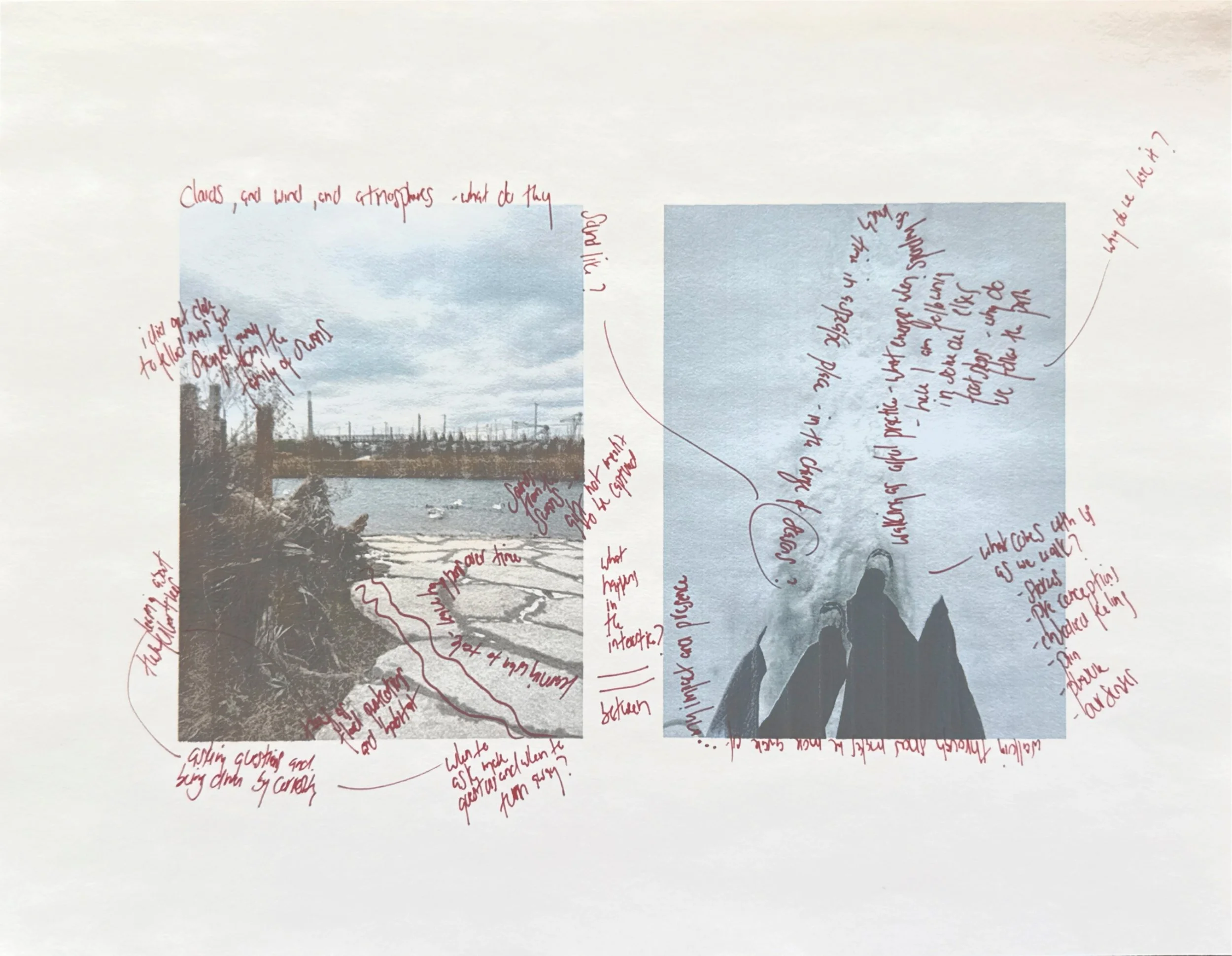
Annotated photos taken while walking and field recording on December 3, 2025 (left) and January 16, 2026 (right). On December 3rd it was too windy to record and on January 16th the atmosphere was still and quiet apart from my boots crunching in the snow.
Urban-natural listening
In her chapter “Listening to Traffic with Guts and Antennae,” Andra McCartney unpacks some responses to, and conceptions of, traffic noise; troubling the imposed binary of nature sounds as good, soothing, desirable and city sounds as grating, annoying and bad. She suggests that roads and their margins;
are ecotones or landscapes of tension where intersecting habitats of plants, animals, cars, bicycles, motorbikes, trucks, trailers, recreational vehicles, pedestrians […] are ordered by laneways, held and released by traffic signals, covered with dust, gravel, tarmac, and suffused with the whines, roars, thrums, and tickings of passing vehicles, as well as their spectacle, smells and toxic emissions (2019; 233).
An ecotone is a transitional space between ecologies, blending habitats and creating a higher diversity of species. The roadway is full of life, even if we choose not to notice.
McCartney thinks with Hildegard Westerkamp’s well known Kits Beach Soundwalk noting that the “drone of distant traffic” she hears in the work “forms a fulcrum between interfering city and intimate nature with its doorway to imagination” (2019; 234). I wonder, what does this doorway to imagination open up? Perhaps an opportunity to break down what AM Kanngieser describes as a “Eurocentric fetish for pre-colonial natures” that imagines ‘nature’ as an elsewhere that is “discrete, unmediated, and possessable” (2023; 690). Attuning to traffic offers a different sense of place. McCartney notes that traffic sound is often pushed back by field recordists to reveal more nature sounds, suggesting that soundwalking can productively bring traffic noise to the fore, causing us to realize what we normally filter out (2019; 236). She shares reflections from listeners on how they engage with traffic sounds, and even use it as a tool for mediation (following rhythms or transforming traffic into something else like wave sounds). McCartney concludes “if we listen, attention to the daily sonic experience of traffic can aid in thinking about how mobility is valued in different situations, and, in deeper ways, how traffic moves all of us” (2019; 240).
Listening to the overlapping tensions of the road and its margin might be one manner of brining an awareness to, and offering a critique of, the essentialization of nature. Expanding beyond “mainstream” practices of soundwalking that valorize “ecological clarity in pristine environments” also moves towards an ethical consideration of the ways in which we listen (and the stories we tell about what we hear) (Droumeva 2023; 91).
—
Droumeva, Milena. “Soundwalking extinction: Listening on borrowed time.” In Soundwalking through Time, Space and Technologies, edited by Jacek Smolicki, 78-95. New York: Routledge, 2023.
Kanngieser, AM. “Sonic colonialities: Listening, dispossession, and the (re)making of Anglo-European nature.” Transactions of the Institute of British Geographers 48, no. 4 (2023): 690-702.
McCartney, Andra. “Listening to Traffic with Guts and Antennae.” In Sound, Media, Ecology, edited by Milena Droumeva and Randolph Jordan, 233-241. London: Palgrave Macmillan, 2019.
Disrupting listening
Listening disrupts our sense of the world around us. For Hildegard Westerkamp, “listening is inherently disruptive as it puts a wrench into habitual flows of time, habitual behaviours of daily life” (2019; 46). Technologies, like simple field recorders, can further this disruptive capacity through meditation and amplification. Guiding students during a soundwalk through Grange Park in Toronto I was excited to see their reactions when listening to the environmental sounds around them through a Zoom H1 handy recorder used for field recording. Such a simple device transforms the existing soundscape as it picks up and amplifies sounds.
In his book Listening After Nature, Mark Peter Wright describes; “a field recording is only ever a partial document. It is a slice of one possible truth remade by the ears of another, elsewhere” (2022; 78). Field recordings, the ones we do take, are never neutral or complete. The field of acoustic ecology in Canada is experiencing an emergent critical wave of scholarship calling into question the field’s history of silencing Indigenous presence, or relegating Indigenous presence to a past tense, as well as a lack of embodied perspectives on sound (framing field recordings as neutral, objective captures of a place), and contending with the material and environmental impacts of recording technologies themselves, such as the microphone’s connections to natural resource extraction.
For Wright, the erasure of the field recordist and technology (and their disruptive presence) as a marker of a ‘quality’ recording is troubling. Instead he encourages that we critically engage with recording technologies themselves and that wind noise might be one “critical ally” to help draw attention to the recording apparatus itself; prompting a practice of “listening-with […] atmosphere, technology and practice” that will bring relations and process to the fore (rather than becoming caught up on creating high-fidelity sound objects (2022; 129).
If we are to listen and record in more ecological ways, Wright suggests that noticing the glitch is as important as the signal itself (2022; 144). Paying attention to, and tending to, disruptions of the mediated/recorded soundscape, and our expectations as field recordists, crafts an openness to more-than-human worldings and experiences. I am inspired by Westerkamp’s attention to the atmospheric forces of wind as it co-creates with elements, environments and infrastructures. What happens when we pay attention to the material dimensions of how sounds are recorded, transformed and transmitted?
“Go out and listen to as many sounds created by wind as possible. Listen for low-pitched and high-pitched ones, for those which continually change their pitch and also their loudness. What kinds of structures produce what kinds of sounds when touched by wind? What effects do the various kinds of sounds have on you?
If it is fascinating to listen to the acoustic interplay between wind and object it becomes even more exciting to listen to that between wind and other sounds. What happens to an existing sound when it is caught, thrown about and carried away by the wind?”
- Hildegard Westerkamp, Soundwalking the Wind, 1974/2001.
—
Westerkamp, Hildegard. “The Disruptive Nature of Listening: Today, Yesterday, Tomorrow.” In Sound, Media, Ecology, edited by Milena Droumeva and Randolph Jordan, 45-63. London: Palgrave Macmillan, 2019.
Westerkamp, Hildegard. “Soundwalking the Wind.” In The Journal of Acoustic Ecology 2, no. 1 (2001): 18-19.
Wright, Mark Peter. Listening After Nature: Field Recording, Ecology, Critical Practice. Bloomsbury, 2022.