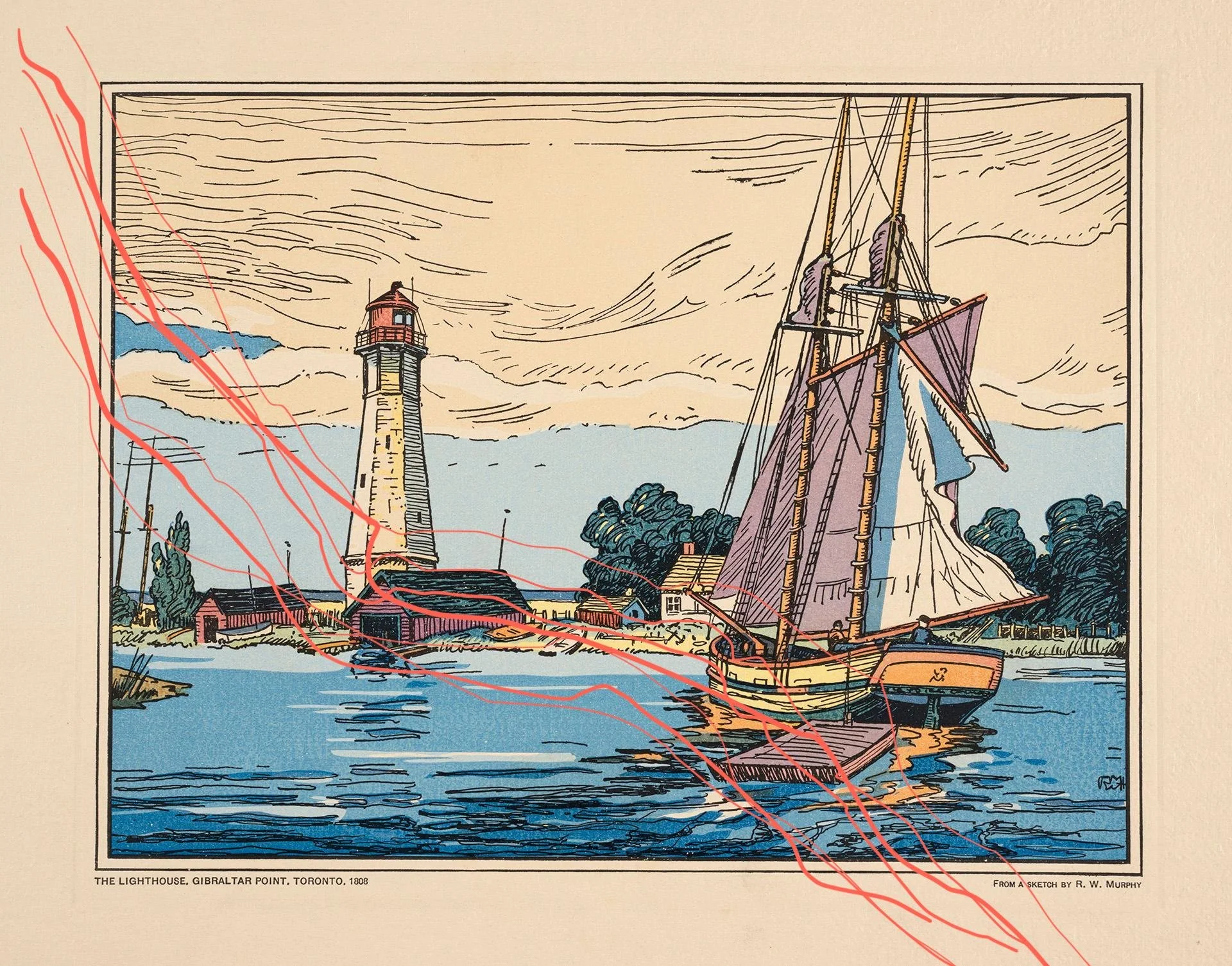
Seven walk traces over ‘The Lighthouse, Gibraltar Point, Toronto, 1808’ by R. W. Murray, 1934, 2026.
A line traced by walking, 2026. Soundscape composition, 4 minutes 20 seconds.
This soundscape composition was formed by walking the space between the Gibraltar Point Lighthouse and the shoreline of Lake Ontario over the course of a week. Field recordings from the site are woven together with a narrative formed through research and experiences of listening to/at the Lighthouse.
As one of Toronto’s oldest buildings, the Gibraltar Point Lighthouse is deeply embroiled in the city’s colonial history. The lighthouse’s location was chosen by Lieutenant Governor John Graves Simcoe in the late 1700s because, in his view, the tip of Centre Island was, like the Rock of Gibraltar, a perfect site for military fortifications. Today, over 200 years since it was built, the lighthouse is no longer the same distance from the shoreline that was so carefully selected by Simcoe. In those 200 years, sediment deposition and land reclamation projects have increased the size of the island gradually moving the lighthouse further and further from the shoreline (TPL, Online). Originally about eight meters from the lake the lighthouse is now over 100 meters away.
Through daily walks—accompanied by my Zoom H5 Handy Recorder—I traced the movement of the lighthouse, paying attention to the acoustic ecology of the shifting space between Lighthouse and shoreline as the colonial structure becomes less and less capable of executing its original wayfinding function. The act of walking produced different modes of attention and resonances, like the slow movement of steps across pebbles at the shoreline. Walking and listening I asked; What can we learn by foregoing a desire to orient (way find) and embracing getting lost in listening? What stories emerge from the space between the lighthouse and the shoreline of Lake Ontario?
Composed during the Walking & Art Residency led by Sarah Cullen and Simon Pope at Gibraltar Point Centre for the Arts.